How to Teach Kids in Charter Schools about Time Management
Time management is one of those skills that sounds simple until you try to teach it to a child. It is not just about clocks and calendars. It is about helping young learners understand that their time has value, that priorities matter, and that planning ahead makes hard things easier. For families choosing personalized education paths like those offered through charter schools, this skill becomes even more essential.
In flexible learning environments, students often have more control over their schedules than they would in a traditional classroom. That freedom is powerful, but it can also be overwhelming without the right guidance. Teaching kids to manage their time well does not happen by accident. It takes intentional effort, the right tools, and a thoughtful approach tailored to each child’s learning style.
Why Time Management Matters More in Charter School Settings
Charter schools, especially those that support home study or blended learning models, give students a level of independence that most traditional schools do not. That independence is a major advantage. Students can learn at their own pace, pursue topics they are genuinely curious about, and build a schedule that fits their lives.
But that same flexibility creates a challenge. Without a fixed school bell or a teacher calling the class to order, students need internal systems for managing their time. A child who has never learned to prioritize tasks or estimate how long something will take can quickly fall behind, feel overwhelmed, or burn out from poor planning.
This is why time management is not a soft skill to be taught later. It is a foundational academic and life skill that supports everything else a student does.
Start with Awareness Before You Add Structure
Before you introduce planners, timers, or schedules, help your child develop an awareness of time itself. Many younger students genuinely do not understand how long an hour feels or how quickly a week passes. Starting with awareness creates a foundation that makes all the other strategies stick.
Try this: for one week, ask your child to estimate how long a task will take before they start, then track the actual time afterward. This is called time estimation practice, and research consistently shows it helps students become more accurate planners over time. The American Psychological Association has highlighted how metacognitive strategies like self-monitoring improve academic performance in young learners.
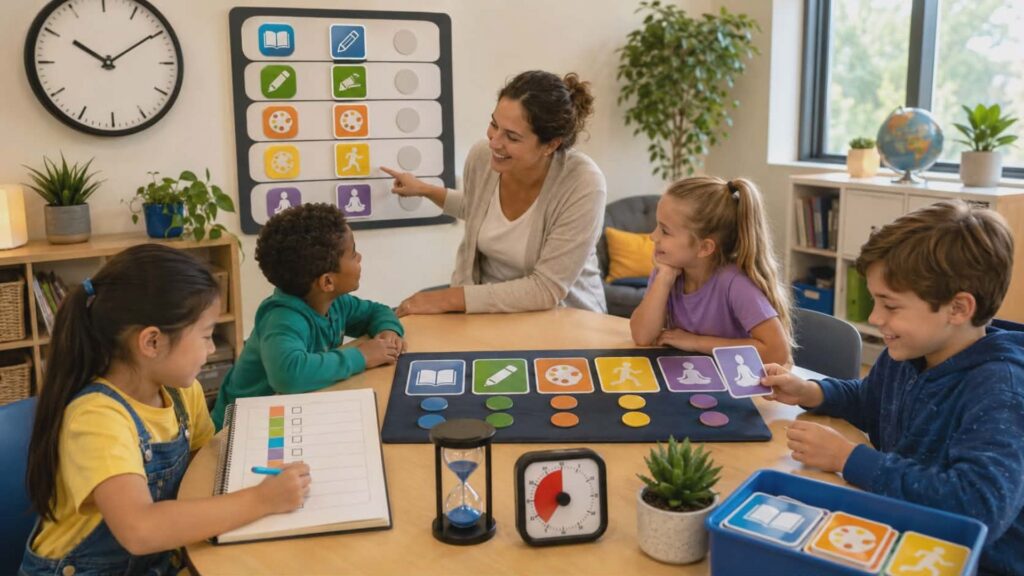
This exercise works well for upper‑elementary students and older. For younger children, you can simplify it by using visual timers or sandglass timers to make time tangible and visible.
Build a Routine That Mirrors Their Learning Style
One of the most meaningful things about charter school education is that it honors the fact that every child learns differently. Some kids are morning learners who do their best work right after breakfast. Others hit their stride in the afternoon. Some need movement breaks to stay focused.
Others prefer long, uninterrupted work sessions.
A good time management system respects these differences. Sit down with your child and map out their natural energy patterns throughout the day. Then build a daily routine that places demanding subjects during high-energy windows and lighter tasks during lower-energy periods.
A simple structure might look like this:
- Morning anchor – A consistent start time that signals the learning day has begun. This does not need to be 8 a.m., but it should be regular.
- Work blocks – Chunks of focused time, typically 25-45 minutes for elementary students and 60-90 minutes for high schoolers, depending on the subject.
- Scheduled breaks – Short, intentional breaks that allow the brain to reset. These are not rewards. They are part of the plan.
- End-of-day review – Five to ten minutes to look at what was completed and what carries over to tomorrow.
This kind of structure is not about rigidity. It is about giving your child a reliable framework they can operate within without needing constant reminders.
Teach the Difference Between Urgent and Important
This is a concept that even many adults struggle with. Urgent tasks demand immediate attention. Important tasks have long-term value. The problem is that children, like many adults, tend to default to urgent tasks and avoid important ones until they become crises.
Teaching this distinction early changes how students approach their workload. Help your child sort their tasks into a simple two-by-two grid: tasks that are both urgent and important get done first, tasks that are important but not urgent get scheduled, tasks that are urgent but not important get delegated or minimized, and tasks that are neither get eliminated.
You do not need to use the formal name for this framework, but the concept is worth practicing regularly. Walk through it with your child at the beginning of each week, using their actual assignments and activities. Over time, they will internalize the thinking process and start doing it on their own.
Use Physical Tools That Match Your Child’s Age
Digital tools have their place, but physical planning tools tend to work better for younger students because they are tactile, visible, and do not carry the distraction risk of screens. A wall calendar, a whiteboard, or a paper planner gives kids something they can touch, write on, and see at a glance.
For elementary-aged students, consider a simple weekly chart with three to five tasks per day written in their own handwriting. The act of writing reinforces memory and ownership. Checking off completed tasks also provides a small but meaningful sense of accomplishment that motivates continued effort.
Older students can graduate to more sophisticated tools. A weekly planner with time-blocked sections works well for middle and high school students managing multiple subjects, extracurricular activities, and personal goals. Some students thrive with digital tools like Google Calendar, which allows them to set reminders and color-code by subject or activity type.
The key is to let the child have input into which tools they use. Ownership of the system increases the likelihood that they will actually use it.
Make Long-Term Projects Feel Manageable
One of the biggest time management failures for students at every level is procrastination on long-term projects. Without external deadlines imposed by a classroom environment, home-learning students can be especially vulnerable to putting off big assignments until the last moment.
The fix is to teach backward planning. Start with the final deadline and work backward to identify all the steps that need to happen before that point. Each step gets its own mini-deadline built into the weekly schedule.
For example, if a student has a research paper due in four weeks, the backward plan might look like this: choose a topic in week one, complete research and notes in week two, write a first draft in week three, and revise and finalize in week four. When each phase has its own target date, the whole project becomes a series of smaller, doable tasks rather than one looming obligation.
This approach mirrors the kind of project management thinking that students will use in college and careers. Starting early builds the habit, and the habit pays off for life.
Involve Parents and Supervising Teachers as Coaches
In a charter school setting, parents and credentialed supervising teachers play a unique and important role. They are not just observers. They are partners in the educational process. That partnership extends naturally into time management coaching.
Parents can help by modeling good planning habits themselves, by conducting brief weekly check-ins with their child about progress, and by resisting the urge to rescue children from the natural consequences of poor time choices. Letting a child experience a low-stakes deadline miss early on is far more instructive than preventing every failure.
Supervising teachers at schools like Horizon Charter Schools can offer structured support, suggest resources, and help families identify whether time management struggles are related to the planning system or to something deeper, like learning differences that may need additional support.
How Blended and Flexible Learning Models Support Time Management Growth
The structure of a student’s learning program matters when it comes to building time management skills. Schools that offer flexible models, including blended learning options, give students natural opportunities to practice managing their time in a real environment with real consequences.
Understanding the differences between learning formats can help families choose the approach that best supports their child’s development. If you are weighing your options, it is worth reading about blended learning vs traditional learning to understand how each model shapes the student’s day-to-day experience and what demands each places on a learner’s self-direction.
Students in blended or supported home study programs benefit from having some external structure, like scheduled meetings or check-ins, while still building the independent habits that serve them long-term. This balance is one of the reasons why families choose personalized charter school options over fully self-directed alternatives.
Watch for Signs That Your Child Is Struggling
Not every child will take to time management strategies naturally, and that is completely normal.
Some children need more time to develop executive functioning skills, which are the mental processes that help people plan, focus, and manage tasks. These skills are still developing well into the mid-twenties, so patience and consistency matter more than perfection.
Watch for signs that your child may need additional support. Chronic procrastination, persistent difficulty estimating time, extreme frustration when plans change, or an inability to start tasks independently can all signal that a child needs targeted strategies or professional support beyond what a standard planning system provides.
If you see these patterns, talk to your supervising teacher early. Early intervention is far more effective than waiting until academic performance suffers.
Celebrate Progress, Not Just Completion
Time management is a skill, and like any skill, it improves with practice and feedback. Children who are learning to manage their time need encouragement along the way, not just praise when they achieve a perfect week.
Celebrate the moments when your child notices they are running out of time and adjusts their plan. Acknowledge the day they finished a difficult task ahead of schedule without being reminded. These small victories are what build the neural pathways that make time management feel natural over time.
Make your feedback specific and genuine. Instead of saying “great job,” try something like “I noticed you started your assignment earlier today without me reminding you. That kind of self-awareness is a real strength.” Specific feedback helps children understand exactly what they did well so they can repeat it.
Conclusion
Teaching kids to manage their time is one of the greatest gifts an educator or parent can give. It is not about control or rigidity. It is about empowering young people to take ownership of their learning, their commitments, and their future.
In a charter school environment where personalized education is the norm, time management becomes both more important and more achievable. With the right structure, the right tools, and the right support from families and educators working in partnership, students can develop habits that will carry them from elementary school through adulthood.
If you are a family exploring flexible, personalized education options in Northern California, Horizon Charter Schools has been supporting students and home educators since 1993. The programs, resources, and dedicated supervising teachers at Horizon are designed to help every student thrive, not just academically, but as capable, self-directed individuals ready for whatever comes next. Reach out to Horizon at 916-408-5200 or visit horizoncharterschools.org to learn how the school can support your family’s educational journey.