Blended Learning vs Traditional Learning In Charter School: Which Model Really Works Better?
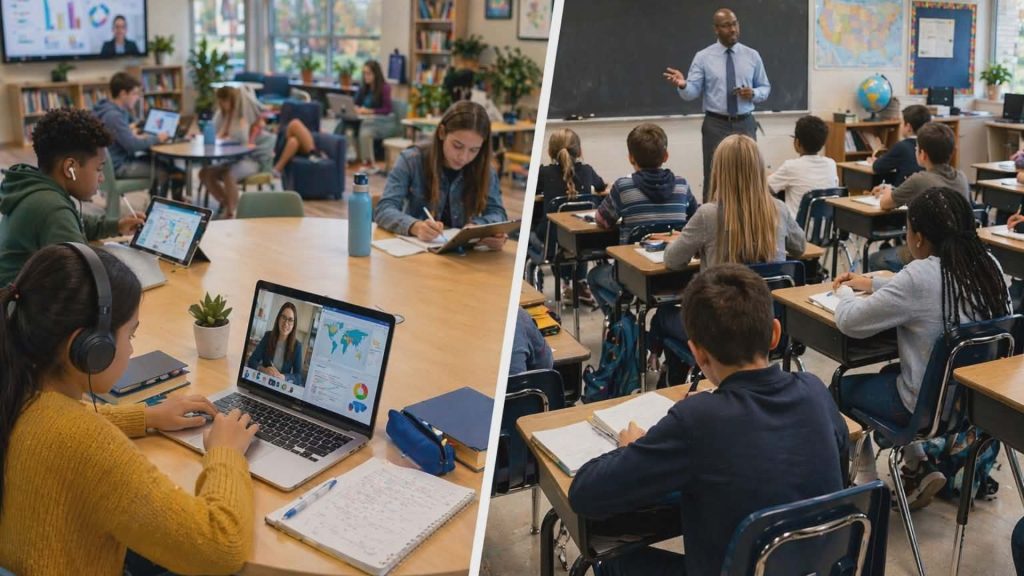
If you’ve ever sat across from your child wondering whether their school is actually the right fit, you’re not alone. Parents today are asking harder questions about approaches to learning and what really drives student outcomes. And one of the biggest debates right now is blended learning vs traditional learning, and which one actually works.
Let’s break this down honestly.
What Is Traditional Learning, Anyway?
Traditional schooling is what most of us grew up with. A teacher stands at the front of a classroom, delivers a lesson, and students follow along. It relies heavily on traditional classroom instruction, fixed schedules, textbooks, and face-to-face interaction.
There’s real value in that. Traditional learning provides structure, routine, and immediate feedback in a way that many students genuinely need. The face-to-face classroom dynamic builds communication skills, supports collaboration, and gives children a physical presence within a shared learning environment.
For some kids, this works beautifully. For others, it falls short.
So What Exactly Is Blended Learning?
Blended learning, also known as hybrid learning, combines online instruction with in-person experiences. Rather than replacing the teacher, it reshapes how classroom time is used. A popular form of blended learning is the flipped classroom model, where students watch video lectures or engage with online materials at home, then use in-person instruction for discussions and hands-on activities.
This approach combines online resources with face-to-face instruction, giving students more control over their learning pace. It uses multimedia tools, educational technology, and real-time interaction to make learning more dynamic and responsive.
Blended learning allows educators to tailor learning experiences to various learning styles – something traditional classroom instruction alone often struggles to do.
Blended Learning vs Traditional Learning: A Real Comparison
When you look at blended and traditional models side by side, the differences go deeper than technology.
Flexibility vs. Structure
Online and traditional methods handle time very differently. Online schooling components in a blended model let students move at their own pace and revisit concepts through e-learning tools.
Traditional models use fixed schedules, which work well for students who thrive on routine but can frustrate those who need more time or want to move faster.
Personalization vs. Consistency
Blended learning programs tend to prioritize personalization. Teachers can use data and feedback from online platforms to identify where a student is struggling before it becomes a bigger issue. Traditional and blended learning differ most here: traditional models often deliver the same lesson to every student, while blended models adapt.
Engagement and Deeper Learning
Student engagement tends to increase when learning feels relevant. A combination of traditional face-to-face mentorship with online tools like multimedia and internet-based resources can push students toward deeper learning. K-12 students especially benefit when their curriculum connects to real-world skills, not just test preparation.
Accessibility and Autonomy
Accessibility is a real concern for many families. Blended models increase access to education for students who may not thrive in a strict classroom setting. They also build autonomy, helping students manage their own learning needs over time, a skill that matters well beyond graduation.
What Does This Mean for Charter School Students?
Charter school students often have more flexibility built into their education by design. A network of charter schools like Horizon Charter Schools has spent decades building learning models that meet students where they are – not where a one-size-fits-all system expects them to be.
Schools that offer blended learning programs within a charter framework can do something rare: combine the accountability and structure of traditional schooling with the personalization that modern learners need. The result is a learning experience that supports each child’s educational goals without sacrificing rigor or connection.
If you’re exploring what that looks like in practice, take a look at the Horizon Charter Schools academies to see how different models are structured for different learners.
How Horizon Approaches This Balance
Horizon Charter Schools has offered a thoughtful combination of supported home study, on-demand learning, blended learning, and traditional learning approaches since 1993.
The school is built around the idea that learning and traditional structures do not have to be in conflict; they can work together.
Credentialed supervising teachers, parent mentors, and workshops support the kind of face-to-face relationship-building that traditional models do well. Meanwhile, online and in-person instruction options give families the flexibility to design a path that fits their child.
For a closer look at how this works, explore the academic programs and curriculum overview, review available student support services, or check out enrollment information and requirements if you’re ready to take the next step.
Conclusion
The best of both worlds is not just a phrase; it’s a real possibility when the right school model is in place. Whether your child thrives with hands-on learning, needs real-time interaction, or works best through online learning at their own pace, the answer depends on knowing your child. Horizon Charter Schools is built for exactly that.
If you’re ready to find a better fit for your student, reach out, explore what’s available, and start the conversation today.