Online Learning vs In-Person Learning in Charter School: Which Is the Right Fit for Your Child?
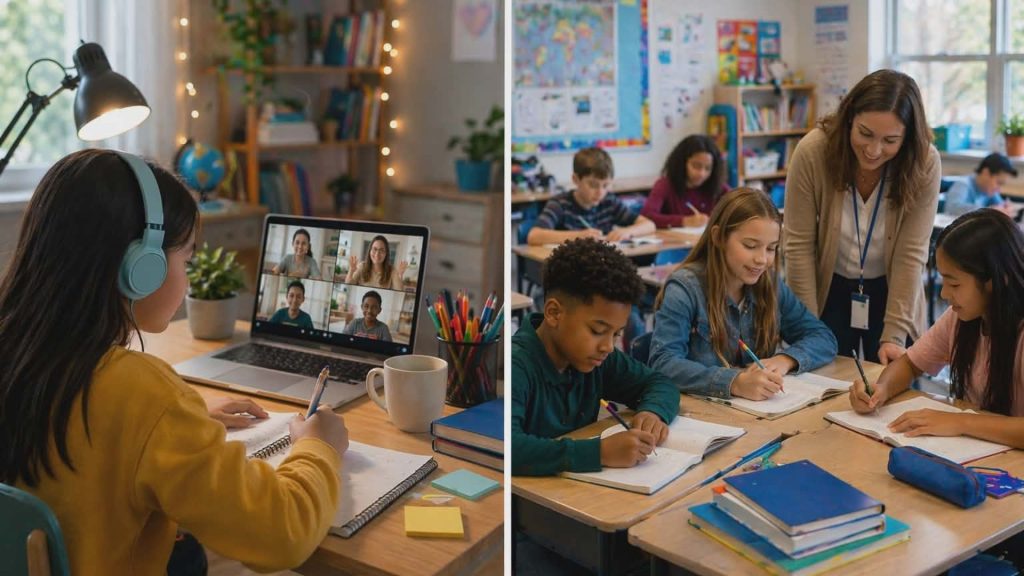
Choosing the right school for your child is one of the most important decisions you will make as a parent. With more options available than ever before, the question is no longer just about which school has the best reputation. Today, many families are weighing something bigger: should their child learn online, in person, or somewhere in between?
This guide breaks down the real differences between online and in-person learning within a charter school setting, so you can make a confident, informed decision.
Understanding the Basics: Online School vs Traditional In-Person Learning
Before comparing the two, it helps to understand what each model actually looks like day to day.
A traditional in-person school follows a set schedule. Students attend a physical classroom, interact face-to-face with teachers and peers, and participate in structured learning activities throughout the school day. This model has shaped the public education system for generations.
Online learning, on the other hand, gives students the flexibility to complete coursework through digital platforms, often on their own timeline. Many online programs combine video instruction, interactive software, and direct support from credentialed teachers, all without requiring a student to leave home.
Charter schools, by design, are built to offer something different from the traditional public school model. They operate with more autonomy over curriculum and teaching methods, which means they are well-positioned to offer both learning models effectively.
Key Differences Between Online and In-Person Charter School Programs
Flexibility and Schedule
One of the clearest differences between online and in-person classes is scheduling. In-person learning follows a fixed routine, which works well for students who thrive on structure and routine. Online learning offers more control over when and how a student engages with the material.
For families with unique circumstances, travel, health needs, or a student who learns better at a different pace, the flexibility of online education can be a genuine advantage.
Social Interaction and Collaboration
Many parents worry that students in online school will miss out on socialization. It is a fair concern. In-person school provides natural opportunities for collaboration, group projects, and the kind of spontaneous social learning that is difficult to replicate in a virtual environment.
That said, many online programs also include live sessions, group discussions, and community events. Distance learning does not have to mean isolation, especially within a supportive charter school community.
Learning Style and Student Fit
Deciding on the best learning model really comes down to knowing your child. Some students are self-motivated, organized, and thrive when given the freedom to direct their own learning.
Others need the physical classroom, direct teacher feedback, and hands-on learning experiences to stay engaged.
Choosing online school works particularly well for students who are independent learners or who have found that traditional in-person school environments were not meeting their needs.
Students who attend online school still have access to credentialed teachers, structured curriculum, and meaningful learning opportunities – just through a different delivery method.
Access to Learning Tools and Technology
Digital learning depends heavily on reliable internet access and a functioning computer. Many online platforms are designed with K-12 students in mind, offering intuitive interfaces and educational technology that support student learning across subjects like science, mathematics, and the arts.
In-person schools tend to provide more hands-on learning activities that are harder to deliver through a screen, including lab work, art projects, and experiential learning opportunities.
What the COVID-19 Pandemic Taught Us
The COVID-19 pandemic forced schools around the world to pivot rapidly to remote learning.
For many families, this was the first real exposure to what online instruction could look like.
Some students thrived during the transition to online learning. Others struggled without the structure of in-person public school.
The pandemic made one thing clear: there is no single right choice for every student. What matters is finding the learning environment that allows each child to grow.
How Horizon Charter Schools Supports Both Paths
Horizon Charter Schools has been navigating these questions since 1993. As a public charter school serving families in Northern California, Horizon offers flexible school options designed around each student’s preferred learning style and family goals.
Whether your child does best in a fully online learning environment or benefits from blended learning that combines online and in-person elements, Horizon has a structured program to match. You can explore the full range of options on the Horizon Charter Schools official website or review the Horizon Charter Schools academies and programs to find the right fit.
Horizon’s approach is built on mentorship, collaboration with parents, and a strong commitment to student success across every grade level. Families can review the Horizon Honors Elementary School curriculum, the Horizon Honors Middle School academic program, and the Horizon Honors High School academic offerings to understand how each level is structured.
Unlike private schools, Horizon is tuition-free, operating as an online public charter within the public education system – which means access to quality education is not tied to tuition payments.
Pros and Cons of Online vs In-Person Learning at a Glance
Online learning offers:
- Scheduling flexibility and autonomy
- Access to virtual learning tools and online courses
- A supportive online learning environment for self-directed students
- Options for online high school students who need alternative pathways
In-person learning offers:
- Daily structure and a consistent school experience
- Face-to-face connection with teachers and classmates
- Hands-on learning activities and experiential learning
- Built-in socialization and community
Neither model is objectively better. The question is not whether online school is better in general, it is whether it is better for your child specifically.
Conclusion
The pros and cons of online versus in-person learning will look different for every family. What matters most is understanding your child’s needs, learning style, and goals. Horizon Charter Schools has spent more than 30 years helping families navigate exactly this decision.
If you are ready to explore a learning model built around your child, not the other way around, reach out to Horizon at 916-408-5200 or visit their website to start the conversation today.